Surprisingly Useful AI Article Enhancements

It’s back. The darling of the internet, our back-to-back Laptop Of The Year Award winner in 2022 and 2023, the laptop which went strangely AWOL in 2024, has returned in the form of its 10th-Generation incarnation. Will it once again be the obvious laptop to buy? My expectations are through the roof, so let’s see if the 10th-Gen Lenovo Legion Pro 7i can deliver?
Lenovo Legion Pro 7i (Gen 10) Specs
| Screen | 16-inch, glossy, 240Hz, 2,560 x 1,600, OLED, HDR display |
| Processor | 2.1-5.4GHz Intel Core Ultra 9 275HX CPU |
| Memory | 32GB DDR5-6400 RAM |
| Graphics | 16GB Nvidia GeForce RTX 5080 Graphics |
| Hard drive | 1TB |
| Connectivity | Wi-Fi 7 Bluetooth 5.4 1 x USB-A 3.2 Gen 2 2 x USB-A 3.2 Gen 1 1 x Thunderbolt 4 1 x USB-A 3.2 Gen 2 1 x HDMI 2.1 1 x 2.5GbE LAN 1 x 3.5mm audio jack |
| Speakers | 2 x 2-Watt Tweeters 2 x 2-Watt Woofers |
| Extra Security | Webcam E-Shutter |
| Webcam | 1,440p |
| Battery | 80Wh |
| Dimensions | 364 x 276 x 27mm |
| Weight | 2.57KG |
| SKU | 16IAX10H |
Features, Ergonomics and Design
The 10th-Gen Legion Pro 7i has an ‘Eclipse Black’ mate chassis, a sporty rear end and sleek lines that will fit well inside an office. Fire it up, though, and and the RGB writes a different story. There’s a light bar at the front, the primary moniker on the lid lights up and the lattice at the back does too. That’s on top of the RGB keyboard which all glows out of the darkness in the way that the best gaming laptops do. The WASD keys aren’t translucent (which I applaud) but Lenovo does provide a key-cap kit if you want to swap-in any lighter coloured keys. It’s quite a fingerprint magnet, but that doesn’t stop it looking awesome. So, the first box is ticked.


The 16-inch, high-resolution, 2,560 x 1,600 screen is generally excellent. It’s an OLED, so we expected the colours and contrast to be exemplary. However, its HDR chops mean that it’s one of the very best at displaying very bright and very dark details at the same time. You might need to drop the (impressive 500-nit) peak brightness down to stop highlights blowing out, but it’s good having a screen that can offer better-than-usual brightness. The HDR also means that both colourful and monochromatic gradients are rendered smoothly.
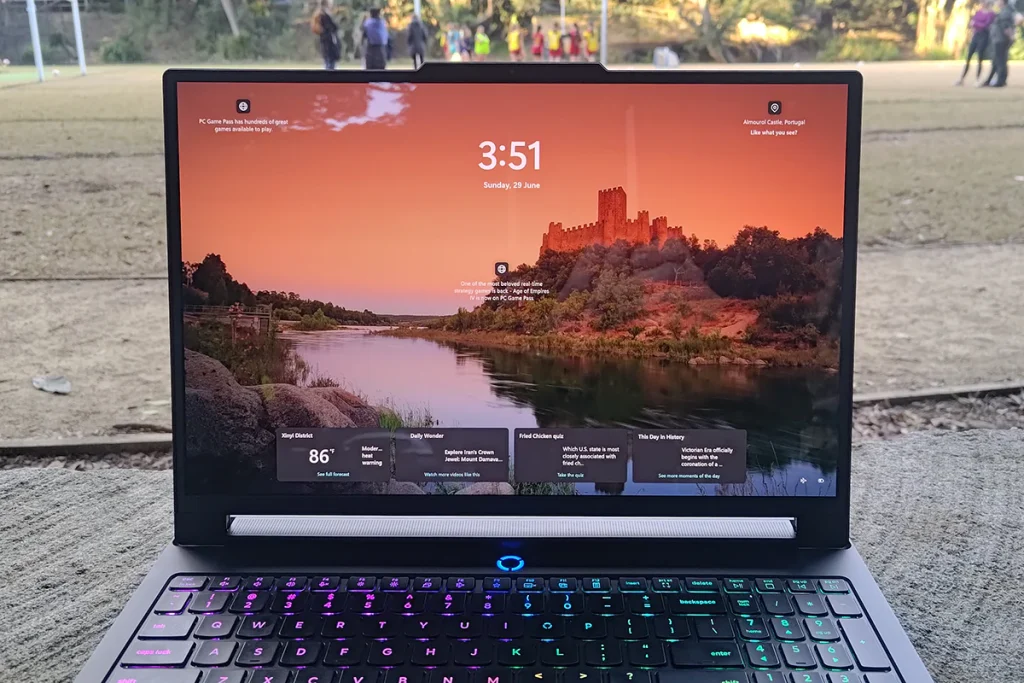
It has a 240Hz refresh rate which marries with the quick OLED pixel-response time to keep very fast-moving objects sharp and blur free. It’s Nvidia G-Sync compatible, so there’s no image tearing. It also supports 100 per cent of the difficult DCI-P3 colour gamut which designers will like. It’s almost perfect but the glossy surface means it can easily turn into a black mirror when displaying dark content or you’re in a bright environment.

Inside, there are four 2-Watt speakers – two tweeters and two woofers. They get loud and punchy and deliver excellent, well-rounded, bassy audio with good fidelity from the top to the bottom end.
The lozenge-shaped keys are very crisp and accurate to type upon (and game with) for extended periods. They’re low travel but perhaps a little stiff for people who type a great deal. There’s also a full number pad plus full-sized arrow keys (yay!) that are isolated and easy to reach for.

The trackpad is smooth and accurate. Just note that it can get a (ever so slightly) warm when under load (but it’s nothing like its ancestors).
There are no Windows Hello log-on security features but the main webcam is excellent thanks to its 1,440p sensor capturing very sharp video, even in low light. There’s an E-Shutter switch on the side that disables it when you want to assure privacy. It’s also partnered by an impressive microphone array that captures very clear audio, even in noisy environments.
All in all, Lenovo’s 10th-Gen Legion Pro 7i is a joy to interact with.
Ports


Inside there’s Wi-Fi 7 and Bluetooth 5.4. So, that’s pretty much the latest and greatest everything.
Features, Ergonomics and Design Score: 5/5
Performance
Inside the 10th-Gen Legion Pro 7i is an Intel Core Ultra 9 275HX (Arrow Lake) CPU with eight Performance cores and 16 Efficient cores that operate between 2.1 and 5.4GHz. It’s also got an NPU (that’s capable of 8 TOPS) and an integrated octa-core GPU that operates at 1.9GHz. In our review unit, it was flanked by 32GB of quick DDR5-6400 RAM and a (PCIe 4.0)1TB drive. Note that Lenovo provides the option to switch up to a quicker PCIe 5.0 version for $70. Just note that, in addition to being faster, it will also consumer more power and run hotter.
Graphics come via Nvidia’s high-end GeForce RTX 5080 GPU with its 16GB of GDDR7 RAM. Lenovo’s boost technology (and 400-Watt Power Brick) can feed it 175-Watts of power.
It’s the first premium gaming laptop to feature increased power and automated overclocking, so I was very keen to see if it could break some of our benchmarking records. I didn’t have to wait long. For newcomers, we provide a mathematically derived score out of five where one represents the weakest score we’ve ever seen and five is the best.

General Computing & CPU Tests
In the general computing PCMark 10 benchmark, which utilises every component in the system, The 10th Gen Legion Pro 7i scored 9,602 which is the fastest score we’ve ever seen on a review laptop. Score 5 / 5
Related: Best Business Laptops for work & school
Related: Best Gaming Laptops
Related: Best Portable Laptop
In the CPU-focused Cinebench rendering tests, it scored 5,801 in the rapid R15 test and 35,529 in the longer R23 version. The following speaks for itself: Score 5 / 5
Next up was the UL Procyon Photo Editing test which uses Adobe Photoshop and Lightroom Classic. The Legion Pro 7i scored 9,602. Score 5 / 5
Other processor-intensive benchmarks included UL Procyon Microsoft Office benchmarks. In the standard test (which got changed in March, meaning we can’t compare it to many previous results and so don’t use it for ranking right now) it scored 7,799. In the multi-platform version it scored 318,000 which is another 5 / 5 performance. In the Procyon Ai Vision test (Windows, CPU, Float 32) it scored 192 (Score 5 / 5).
It’s fair to say that the 10th Gen Lenovo Legion Pro 7i is currently the fastest laptop we’ve seen, in these areas.

General Computing & CPU Score: 5 / 5
Graphics & Gaming Performance
Our Pro 7i review unit had an RTX 5080, but you can use Lenovo’s online configurater to switch to a 5070 or a 5090. We’ve already seen Pioneer’s Dreambook destroy the joint with its 5090 running at stock speeds, so how would a boosted RTX 5080 compare?
The raw scores are:
| 3DMark Benchmark | Resolution | Score | Average Framerate | Star Rating |
|---|---|---|---|---|
| Speed Way (Ray-tracing) | 1,440p | 5,779 | 57.8fps | 5 / 5 |
| Port Royal (Ray-tracing) | 1,440p | 14,507 | 67.2fps | 5 / 5 |
| Steel Nomad | 4K | 5,364 | 53.6fps | 4.9 / 5 |
| Steel Nomad Light | 1,440p | 24,106 | 175.6fps | 5 / 5 |
| Solar Bay (Ray-tracing) | 1,440p | 107,238 | 406.5fps | 5 / 5 |
| Time Spy | 1,440p | 20,858 | 130.1fps | 4.8 / 5 |
| Fire Strike Extreme | 1,440p | 23,532 | 110fps | 4.7 / 5 |
| Wild Life Extreme | 4K | 43,592 | 261fps | 4.9 / 5 |
| Night Raid | Full HD | 91,795 | 978fps | 5 / 5 |
| Graphics & Gaming Performance Score | – | – | – | 5 / 5 |
So… no problem playing games either, then.
Just to double check, I also ran the Call of Duty: Black Ops 6 benchmark. At default settings (chosen by the game) it averaged 128fps with the lowest one per cent of frames (1% Low score) running at 96fps. That was at a 2,560 x 1,600 resolution with Extreme Settings. Very impressive. With DLSS 4 frame generation turned on, these scores boosted to 184fps and 148fps respectively. At a Full HD resolution with Minimum settings it averaged 220fps with a 1% Low score of 183fps (251fps and 224fps with DLSS 4 respectively).
tl;dr it’s a gaming laptop that’s superb at gaminng.
I also ran some other GPU benchmarks. The GPU version of the Procyon Ai Vision test saw a score of 884 (4.4 / 5). I’ve still no idea what that means. But, it’s a good score for those using the GPU for Ai tasks.
Of more interest was the UL Procyon Video Editing benchmark which uses Adobe Premiere Pro to render four ~900MB video files. The longest time seen (UHD, H.265, 60fps) was just 44 seconds. For comparison, a MSI’s 5070-wielding Crosshair took 51 seconds while the 4090-wielding Pioneer DreamBook took 45 seconds.
Graphics & Gaming Performance Score: 5 / 5
Cooling
Afficienados of the range will note that a feature of Lenovo’s Legion Pro 7i line has historically been that it runs very hot and very loud. The good news is that the Gen 10’s “Legion ColdFront: Vapor technology with Integrated Hyper Chamber” vapour-chamber-based cooling, keeps the base of the laptop cool, even when it’s under load. While the keyboard can get warm, it’s not by much and won’t cook your fingers. The fans can ramp up to a constant, low-but-audible whoosh when the laptop is working hard, but it’s no worse than rivals. There was also practically no thermal performance throttling when we ran the 30-minute version of the Cinebench R23 test.

Portability & Battery Life
Another historical feature of Legion Pro 7is has been poor portability. While the Gen 10 version has shown improvement in this area, it’s still disappointing: the 80Wh battery ran out PCMark 10 Modern Office battery benchmark for just 7 hours 8 minutes. It ran the UL Procyon Microsoft Office battery benchmark for a pitiful 4 hours 39 minutes. I expect more from a laptop with Nvidia-Intel-MUX technology nowadays – rivals can triple that nowadays.
You can buy versions of the 2025 Pro 7i with a 99Wh battery, but that will increase the weight. It’s already 2.57KG (which is reasonable for a stacked 16-inch gaming laptop). However, note that the (impressively slim) power supply and cables add a hefty 1.24KG to the mix.
Still, build quality is impressive with the chassis being rigid and the screen not flexing very much when a twisting force is applied. The hinge is very sturdy and doesn’t wobble at all. It’s very well built and should survive life on the road.
Portability & Battery Life Score: 1.3 / 5
Price, Value & Availability
There are some scarcely believable five-figure prices being bandied about for premium gaming laptops this year so, in that context, the $5,890 sticker price for this SKU (16IAX10H) of Lenovo’s Gen 10 Legion Pro 7i isn’t that terrible. However, as we went to press it dropped to $4,999 in one of Lenovo’s Regular sales (which will likely end any day, now). Lenovo’s configurator means you can downgrade or upgrade components to adjust the price, too.
Value Score: 3 / 5
Conclusion: Should You Buy The Lenovo Legion Pro 7i (Gen 10)?
In many cases, the answer is a resounding, yes. Portability and price aside, it’s almost perfect. Traditional rivals, in the form of Asus’ Zephyrus and MSI’s Raider, will soon be dropping, but the Legion Pro 7i will be ready and waiting. Its high RRP means it’s just a smidge too expensive to win our top honours outright – the cheaper MSI Crosshair is a better choice for those on a budget. However, when the sale price is taken into account, the Lenovo edges ahead.
When we update our Best Laptop Group Test, in the next few days, either model could be sitting atop the throne. However, Because you can by the Lenovo Legion Pro 7i (Gen 10) right now for under five grand, it’s become, not just our Best Gaming Laptop, but our Best Laptop overall. Congratulations Lenovo!
Overall score: 5 / 5


Last Updated on June 30, 2025 by Nick Ross
Lenovo Legion Pro 7i (Gen 10) Scores
- Features, Ergonomics & Design
- General Computing & CPU Performance
- Graphics & Gaming Performance
- Portability & Battery Life
- Value For Money
Summary
Lenovo’s Gen-10 Legion Pro 7i represents a return to form that sees it once again lead the pack. It’s supremely powerful, looks great and handles brilliantly. Just note the low portability.