
Surprisingly Useful AI Article Enhancements
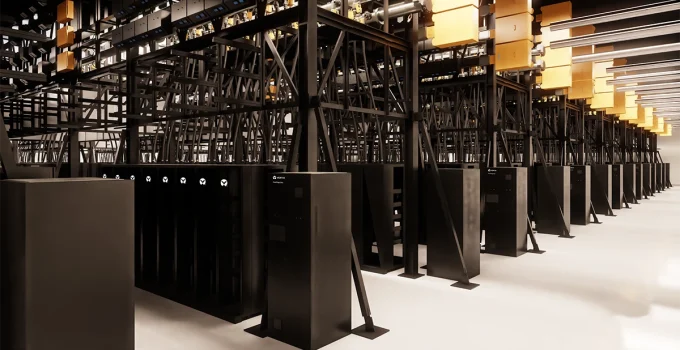
Vertiv has developed a production-grade digital twin capability for its SmartRun integrated infrastructure platform, designed to work within the Nvidia Omniverse DSX Blueprint and aimed at accelerating the design, simulation and deployment of AI factory infrastructure.
The capability represents the first phase of a broader, multi-phase digital twin roadmap from the company, which is listed on the NYSE under the ticker VRT. Vertiv intends the digital twin to help bridge the gap between the pace of accelerated compute innovation and the readiness of the physical infrastructure required to support it.
The Problem With Current Planning Methods
As AI deployments push toward higher power densities and larger facility capacities, data centre operators face growing pressure to translate each new generation of computing hardware into built infrastructure more quickly and with fewer errors.
The conventional approach relies on document-based planning processes and handoffs between separate teams responsible for power, cooling, controls and deployment. Vertiv argues this model struggles to keep pace with the speed at which new compute platforms are now reaching the market.
The SmartRun digital twin shifts that process to a model-based approach, where infrastructure can be designed, simulated and validated as a single integrated system within a virtual environment before any physical build-out begins. By capturing system configurations and dependencies digitally, the tool is intended to reduce late-stage design changes, lower integration risk and improve coordination across project teams.
Designing Infrastructure As A Single System
Scott Armul, Chief Product and Technology Officer at Vertiv, framed the digital twin as a response to the growing complexity of AI infrastructure planning.
“AI infrastructure can no longer be planned one compute generation at a time,” Armul explained. “To deliver more tokens per second per megawatt, customers need power, cooling, controls and deployment workflows to be designed as one interdependent system.”
“The Vertiv SmartRun digital twin helps encode Vertiv’s infrastructure expertise into configurable, simulation-ready building blocks that support faster, more confident AI factory planning.”
Armul pointed to the company’s plans to extend the model-based approach to Vertiv OneCore Rubin DSX, a prefabricated hybrid data centre platform.
“As we extend this approach to Vertiv OneCore Rubin DSX, Vertiv is helping customers translate future compute requirements into deployable physical infrastructure before those requirements reach full deployment scale,” he added.
How The Digital Twin Fits Into Vertiv’s Roadmap
The SmartRun digital twin is positioned as the first phase of Vertiv’s broader AI factory digital twin strategy. Subsequent phases are expected to extend the digital twin’s role beyond initial design and simulation into deployment, commissioning, lifecycle assurance and future optimisation.
The underlying concept is that engineering intent – the decisions made during early configuration and simulation – should be preserved and carried through the entire infrastructure lifecycle, rather than being lost or reinterpreted at each handoff between project stages.
Nvidia’s Role Through Omniverse DSX
The digital twin capability is built to operate within the Nvidia Omniverse DSX Blueprint, a framework that allows ecosystem partners to build, simulate and optimise digital twins of large-scale AI factory environments.
Vladimir Troy, Vice President of AI Infrastructure at Nvidia, described the collaboration in the context of full-stack infrastructure planning.
“AI factories require full-stack co-design across compute and physical infrastructure,” Troy noted. “Nvidia Omniverse DSX Blueprint helps the ecosystem build, simulate and optimise gigawatt-scale AI factory digital twins using OpenUSD, SimReady assets and power, thermal and operational simulations.”
Related: Best Business Laptops for work & school
Related: Best Gaming Laptops
Related: Best Portable Laptop
“Bringing Vertiv SmartRun into this workflow can help customers evaluate infrastructure choices earlier and prepare for multiple generations of accelerated computing.”
The integration means that infrastructure planners working within the Omniverse DSX environment can access Vertiv’s SmartRun configurations as part of their broader simulation workflows, rather than treating physical infrastructure as a separate planning exercise.
Dassault Systemes Provides The Engineering Platform
The digital twin has been created using model-based systems engineering capabilities from Dassault Systemes, running on the company’s 3DEXPERIENCE platform. That platform provides the engineering foundation for configuration, simulation and validation, while the connection to Nvidia Omniverse DSX extends those capabilities into broader AI factory simulation workflows.
Stephane Sireau, Vice President of High Tech Industry at Dassault Systemes, outlined the significance of the model-based approach.
“Digital twins allow complex infrastructure systems to be represented with the intelligence of their configuration rules, dependencies and engineering intent,” Sireau remarked.
“At Computex, Vertiv, Dassault and Nvidia demonstrate how Vertiv’s AI factory infrastructure is moving from document-based design workflows toward an industrialised, model-based systems engineering approach optimised for speed, quality and system-level performance.”
Computex Taipei Demonstration
Vertiv will demonstrate the SmartRun digital twin at Computex Taipei 2026, presenting it alongside the physical SmartRun infrastructure system. Attendees will be able to explore configuration scenarios and observe how model-based design choices flow into downstream infrastructure planning, coordination and simulation workflows.
The demonstration is intended to show the connection between the physical product and its digital counterpart, illustrating how decisions made in the virtual environment relate to real-world infrastructure outcomes.
The Computex showing brings together the contributions of all three companies involved in the project: Vertiv’s infrastructure hardware and configurations, Dassault Systemes’ model-based engineering platform and Nvidia’s Omniverse DSX simulation environment.
For operators planning AI factory deployments, the practical question is whether a model-based digital twin approach can meaningfully compress the timeline between a new compute platform reaching the market and the physical infrastructure being ready to support it. Vertiv’s position is that by moving design decisions into a shared virtual environment early in the process, teams can identify and resolve integration issues before they become costly problems on site.
Last Updated on June 4, 2026 by Nick Ross


