
Surprisingly Useful AI Article Enhancements
Nvidia has announced DLSS 5, a new version of its AI upscaling technology that moves beyond performance gains to target visual quality, using a real-time neural rendering model to enhance lighting and materials in games.
The technology was unveiled at GTC by Nvidia CEO Jensen Huang. It is expected to arrive in games next spring, with support confirmed from publishers and studios including Bethesda, Capcom, Ubisoft, Tencent and Warner Bros. Games.
What DLSS 5 does
Previous versions of DLSS focused on boosting frame rates by upscaling resolution and generating intermediate frames using AI. DLSS 4.5, launched at CES earlier this year, uses AI to generate 23 out of every 24 pixels displayed on screen.
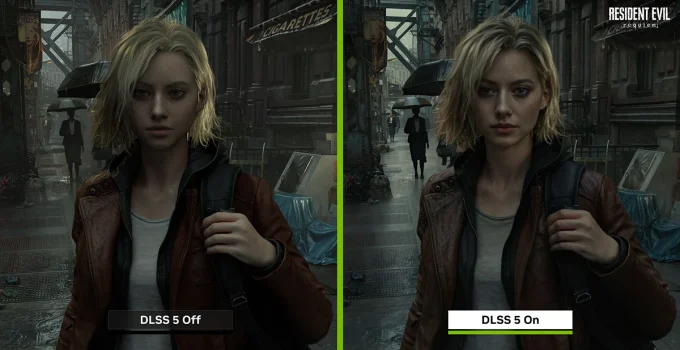
DLSS 5 takes a different approach. Rather than focusing solely on performance, the new version uses an AI model to enhance the visual quality of each frame by adding what Nvidia describes as photoreal lighting and material properties.
The system takes a game’s colour output and motion vectors as input for each frame, then uses a trained neural model to apply enhanced lighting and material rendering that is anchored to the game’s 3D scene. The result is designed to run in real time at up to 4K resolution.
The AI model is trained to recognise complex scene elements such as characters, hair, fabric and translucent skin, as well as environmental lighting conditions like front-lit, back-lit or overcast scenes. It then applies effects such as subsurface scattering on skin, fabric sheen and light interactions on hair, while retaining the structure of the original scene.
Jensen Huang framed the technology in the context of Nvidia’s broader graphics history.
“Twenty-five years after Nvidia invented the programmable shader, we are reinventing computer graphics once again,” Huang stated. “DLSS 5 is the GPT moment for graphics – blending handcrafted rendering with generative AI to deliver a leap in visual realism while preserving the control artists need for creative expression.”
Closing the gap with offline rendering
Nvidia positioned DLSS 5 as an attempt to narrow the visual gap between real-time game rendering and the offline rendering used in Hollywood visual effects.
A single game frame must be rendered in roughly 16 milliseconds, while a comparable frame in a film VFX pipeline can take minutes to hours. Nvidia argued that real-time rendering cannot close this gap through raw compute alone, despite what the company described as a 375,000x increase in compute power delivered across its GPU architectures since 2001.
DLSS 5 is intended to use AI to bridge that difference, applying visual enhancements that would otherwise require far more rendering time than real-time gameplay allows.
Developer controls and integration
Nvidia emphasised that DLSS 5 gives game developers control over how the AI enhancements are applied. The system includes settings for intensity, colour grading and masking, allowing artists to determine where and how the neural rendering is used within a scene.
Integration uses the same Nvidia Streamline framework already used by existing DLSS and Nvidia Reflex technologies.
Studio support
A number of studios have confirmed support for DLSS 5.
Todd Howard, Studio Head and Executive Producer at Bethesda Game Studios, pointed to the technology’s potential for the studio’s titles.
Related: Best Business Laptops for work & school
Related: Best Gaming Laptops
Related: Best Portable Laptop
“With DLSS 5, the artistic style and detail shine through without being held back by the traditional limits of real-time rendering,” Howard commented. “We’re excited to work with this new technology and look to bring DLSS 5 to Starfield and future Bethesda titles.”
Jun Takeuchi, Executive Producer and Executive Corporate Officer at Capcom, outlined the studio’s interest.
“At Capcom, we strive to create experiences that feel cinematic, compelling and deeply believable – where every shadow, texture and ray of light is crafted with intention to enhance atmosphere and emotional impact,” Takeuchi explained. “DLSS 5 represents another step in pushing visual fidelity forward, helping players become even more immersed in the world of Resident Evil.”
Charlie Guillemot, Co-CEO of Vantage Studios, described the impact on Assassin’s Creed Shadows.
“The way it renders lighting, materials and characters changes what we can promise to players,” Guillemot noted. “On Assassin’s Creed Shadows, it’s letting us build the kind of worlds we’ve always wanted to.”
Confirmed game support
Nvidia listed the following titles as confirmed for DLSS 5 support: AION 2, Assassin’s Creed Shadows, Black State, Cinder City, Delta Force, Hogwarts Legacy, Justice, Naraka: Bladepoint, NTE: Neverness to Everness, Phantom Blade Zero, Resident Evil Requiem, Sea of Remnants, Starfield, The Elder Scrolls IV: Oblivion Remastered and Where Winds Meet.
The technology has been integrated into more than 750 games across its previous versions.
Last Updated on March 17, 2026 by Nick Ross


