
Surprisingly Useful AI Article Enhancements
Nvidia has unveiled new Omniverse libraries, Cosmos physical Ai models and computing infrastructure aimed at accelerating robotics development.
The announcements, made at SIGGRAPH, include tools for world reconstruction, spatial reasoning and simulation, supported by the company’s RTX PRO Blackwell servers and DGX Cloud platform.
Combining Ai And Simulation
Rev Lebaredian, Vice President of Omniverse and Simulation Technologies at Nvidia, said the integration of computer graphics and Ai would change the robotics landscape.
“By combining Ai reasoning with scalable, physically accurate simulation, we’re enabling developers to build tomorrow’s robots and autonomous vehicles that will transform industries,” Lebaredian said.
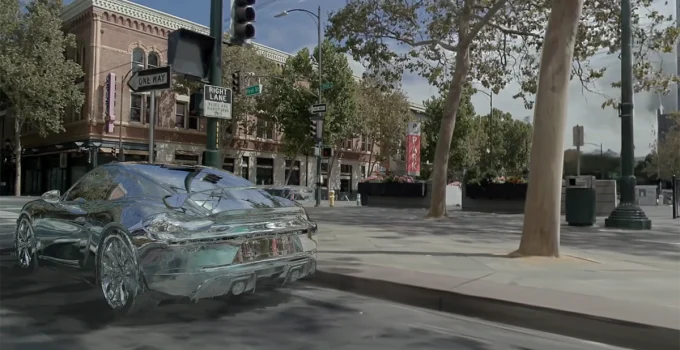
The new Omniverse software development kits and libraries are designed for industrial Ai and robotics simulation applications. These include interoperability between MuJoCo and Universal Scene Description (OpenUSD) and the Omniverse NuRec 3D Gaussian splatting libraries, enabling real-world capture and reconstruction from sensor data.
Isaac Sim 5.0 and Isaac Lab 2.2 are now available on GitHub, with new robot and sensor schemas aimed at closing the simulation-to-reality gap. NuRec rendering has also been integrated into the CARLA autonomous vehicle simulator.
Industry Adoption
Companies adopting the Omniverse libraries and Isaac tools include Boston Dynamics, Figure Ai, Hexagon, RAI Institute, Lightwheel and Skild Ai. Amazon Devices & Services is using the technology to support a manufacturing solution.
Foretellix, a provider of autonomous vehicle toolchains, is integrating NuRec, Omniverse Sensor RTX and Cosmos Transfer to improve its synthetic data generation capabilities. Voxel51’s FiftyOne platform now supports NuRec to aid in data preparation for reconstructions.
Cosmos Enhancements For World Generation
Nvidia’s Cosmos world foundation models, which have been downloaded over 2 million times, are used for large-scale synthetic data generation.
New models include Cosmos Transfer-2, which accelerates photorealistic data generation from simulation scenes, and a distilled version of Cosmos Transfer that significantly speeds up processing on RTX PRO servers.
Lightwheel, Moon Surgical and Skild Ai are using Cosmos Transfer to train physical Ai models by simulating varied conditions at scale.
Cosmos Reason For Advanced Understanding
Nvidia also introduced Cosmos Reason, a 7-billion-parameter vision language model designed for robotics and physical Ai. The model enables data curation, annotation, robot planning and video analytics.
Use cases include automating dataset preparation, enabling robots to interpret complex environments and extracting insights from large video datasets.
Cosmos Reason is being used by Nvidia’s robotics and Nvidia DRIVE teams, Uber for annotating autonomous vehicle training data, and Magna for its City Delivery platform. Other adopters include VAST Data, Milestone Systems and Linker Vision for applications such as traffic monitoring and visual inspection.
Infrastructure For Robotics Workloads
To support these workloads, Nvidia announced its RTX PRO Blackwell servers, which provide a unified architecture for training, simulation and data generation.
Related: Best Business Laptops for work & school
Related: Best Gaming Laptops
Related: Best Portable Laptop
The DGX Cloud service, now available on Microsoft Azure Marketplace, offers Omniverse developers a managed platform for streaming OpenUSD- and RTX-based applications at scale. Accenture and Hexagon are among the first to use it.
Developer Ecosystem Support
Nvidia is introducing an OpenUSD curriculum and certification program with support from AOUSD members including Adobe, Amazon Robotics, Ansys, Autodesk, Pixar, PTC, Rockwell Automation, SideFX, Siemens, TCS and Trimble.
The company is also collaborating with Lightwheel to integrate robot policy training and evaluation frameworks into Isaac Lab, with parallel reinforcement learning capabilities and simulation-ready assets.
The announcements are part of Nvidia’s effort to drive adoption of simulation and 3D technology in robotics and physical Ai development.
Last Updated on August 12, 2025 by Nick Ross


