
Surprisingly Useful AI Article Enhancements
At SIGGRAPH 2024, Nvidia founder and CEO Jensen Huang sat down with WIRED’s Lauren Goode to discuss the future of AI-enhanced human productivity and the growing importance of energy-efficient accelerated computing. Huang highlighted how the intersection of graphics and AI is shaping the future of various industries, particularly in the areas of digital content creation and robotics.
Nvidia has been at the forefront of AI and graphics technology, and the company made several announcements during the event. One of the key announcements was the introduction of a new suite of NIM microservices, designed to support a wide range of workflows. These include OpenUSD, 3D modeling, physics, materials, robotics, industrial digital twins, and physical AI. The NIM microservices aim to enhance developer capabilities, enabling more efficient and innovative solutions across different sectors.
The integration of Hugging Face Inference-as-a-Service on Nvidia’s DGX Cloud was also a significant highlight. This partnership is expected to provide developers with robust tools for building and deploying AI models, making it easier to leverage advanced machine learning capabilities. The DGX Cloud platform offers a scalable infrastructure that supports the growing demand for AI applications.
In addition to these advancements, Shutterstock has launched a Generative 3D Service, leveraging Nvidia’s technology to offer users the ability to create high-quality 3D content. Meanwhile, Getty Images has upgraded its offerings using Nvidia Edify technology, enhancing the platform’s capabilities for generating and manipulating visual content.
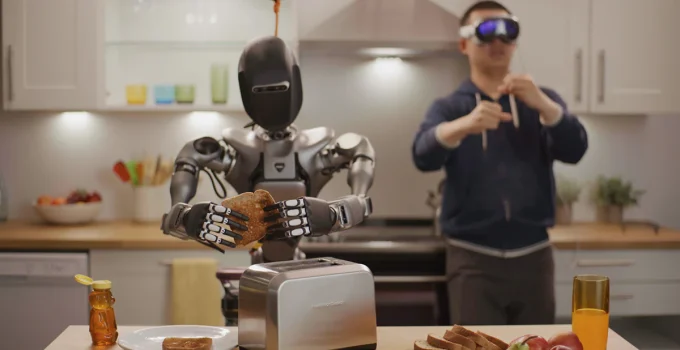
Huang also discussed the introduction of new OpenUSD NIM microservices and reference workflows designed specifically for generative physical AI applications. This includes a program aimed at accelerating the development of humanoid robotics, featuring new microservices for robotics simulation and other advanced functionalities. These tools are designed to facilitate the development of sophisticated AI systems, including those that can interact with the physical world.
WPP, the world’s largest advertising agency, is another example of how Nvidia’s advancements in AI are being applied in real-world scenarios. WPP is using Omniverse-driven generative AI for The Coca-Cola Company, highlighting the practical applications of these technologies in creating brand-authentic content. This collaboration showcases how AI can be used to enhance marketing and advertising strategies, offering new ways to engage audiences.
Huang emphasized the potential of AI to revolutionize various industries, from entertainment to robotics. “The integration of AI and graphics is not just about enhancing visual experiences; it’s about enabling new forms of creativity and efficiency,” he said. “As we continue to develop these technologies, we’re seeing how they can be applied in ways that were previously unimaginable.”
The developments discussed at SIGGRAPH 2024 underscore Nvidia’s commitment to pushing the boundaries of what’s possible with AI and graphics. With ongoing innovations in areas such as generative AI, robotics, and digital content creation, Nvidia continues to play a pivotal role in shaping the future of these fields.
Last Updated on July 31, 2024 by Nick Ross


