
Surprisingly Useful AI Article Enhancements
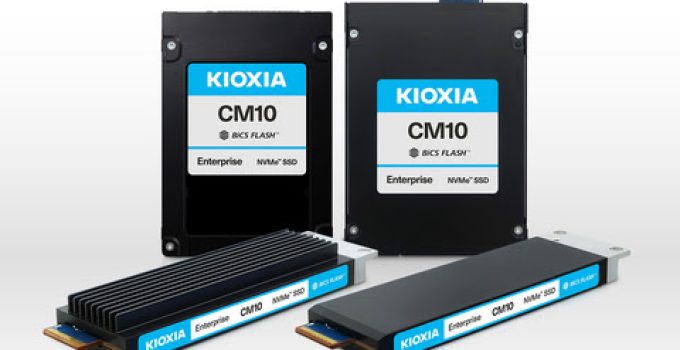
Kioxia Corporation has introduced the CM10 Series of enterprise solid-state drives, the company’s first PCIe 6.0 SSDs and the first to use its BiCS FLASH generation 10 TLC flash memory built on a 332-layer architecture.
The drives are designed for enterprise and AI workloads including inference and context caching, and support the Nvidia CMX architecture. They are also Kioxia’s first enterprise SSDs to offer direct-cold-plate liquid cooling capability, targeting denser AI infrastructure deployments where traditional air cooling is constrained.
The CM10 Series is currently sampling to select customers for functional evaluation, with specifications potentially subject to change ahead of mass production.
Performance Over Previous Generation
Compared to the previous-generation CM9 Series, the CM10 drives deliver up to approximately 92 per cent higher sequential read performance and up to approximately 85 per cent higher random read performance, according to Kioxia.
Those gains are attributed to the combination of the PCIe 6.0 interface and the newer 332-layer flash memory, which also improves power efficiency over the prior generation.
AI Context Caching And Nvidia CMX
Kioxia is positioning the CM10 Series for the growing demand for high-performance context cache storage in AI infrastructure. As AI models scale toward trillions of parameters and context windows expand to millions of tokens, architectures such as Nvidia CMX extend the memory hierarchy beyond GPU memory by using fast flash storage as an additional tier.
Enterprise SSDs are becoming an increasingly visible component of AI infrastructure as a result. The CM10 Series is designed to address those requirements with a combination of performance, capacity and endurance for large-scale deployments.
Form Factors And Capacities
The CM10 Series is available in three form factors: E3.S, E1.S and 2.5-inch. Cold-plate liquid cooling is supported in the E3.S and E1.S 9.5mm form factors, while all three form factors support traditional air-cooled environments.
The 2.5-inch variant differs from the other two in that it uses a PCIe 5.0 interface and BiCS FLASH generation 8 TLC flash memory rather than the PCIe 6.0 and generation 10 flash used in the E3.S and E1.S models.
Capacities range from 1.60 TB to 61.44 TB depending on form factor. Two endurance profiles are available: read-intensive at 1 DWPD (drive writes per day) and mixed-use at 3 DWPD.
Interface And Compliance
The drives comply with PCIe 6.0, NVMe 2.1 and the Open Compute Project (OCP) Datacenter NVMe SSD Specification v2.7, though Kioxia noted that not all requirements of the OCP specification are supported. NVMe Flexible Data Placement (FDP) is included.
Security Features
The CM10 Series includes several security options. Standard configurations include SIE and SED (TCG Opal SSC, with some feature exceptions). SED FIPS 140-3 certification is planned. The drives also support post-quantum cryptography aligned with the CNSA 2.0 recommendations and SPDM 1.4 attestation. SED models are not available in all countries due to local regulations.
Sampling And Showcase
The CM10 Series is being sampled to select customers for functional evaluation. The drives will be showcased at FMS: the Future of Memory and Storage, taking place 4 to 6 August in Santa Clara, California.
Kioxia’s BiCS FLASH technology traces back to its predecessor Toshiba Memory, the company that developed NAND flash memory in 1987. Kioxia was spun off from Toshiba Corporation in April 2017.
Last Updated on July 30, 2026 by Nick Ross
Related: Best Business Laptops for work & school
Related: Best Gaming Laptops
Related: Best Portable Laptop


