
Surprisingly Useful AI Article Enhancements
Enterprise software customers are leaving significant value on the table inside systems they have already purchased, and the gap between insight and action is where most of it gets lost.
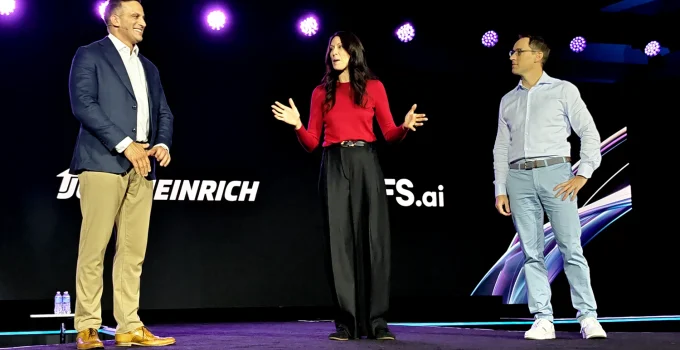
That was the central argument from IFS Chief Product and Customer Officer, Cathie Hall (pictured centre), during the closing session of the IFS Unleashed conference in Orlando, where she unveiled a revamped customer engagement platform called IFS Accelerate and brought two customers on stage to discuss how they are using it.
The 40 Per Cent Problem
Hall opened by acknowledging a tension she hears repeatedly from business leaders. Opportunities to extract more value from enterprise technology have never been greater, but the path from business case to measurable outcome remains difficult to navigate.
“When I speak to business leaders, they’re not just asking about the technology. They’re seeking to unlock that 40 per cent in the investments they’ve already made,” Hall told the audience, referring to IFS’s claim that 40 per cent of enterprise data and capability remains untapped within conventional systems.
She argued the problem is not incompetent people, missing data or weak business cases. It is disconnection.
“It’s because the information and priorities, the people and the actions are disconnected. That can leave value on the table within the systems you already run, in the data you already have, in the capabilities that you’ve already purchased,” Hall continued.
Closing The Gap Between Insight And Action
Hall introduced IFS Accelerate as the platform designed to close that gap. It replaces what was previously known as IFS Success and is underpinned by a customer value portal with IFS Intelligence feeding into it, served through what the company calls the Lifecycle Experience Centre.
“It’s a shared view and context of your priority actions, deliverables and value. It’s not hidden anymore in meeting minutes and emails and PowerPoint presentations, but in an experience you can use every single day,” she explained.
The platform demonstration showed several layers of functionality. At the top level, it provides an overview of a customer’s environment with IFS Intelligence connected in, listing opportunities for improvement alongside recent recommendations and a success plan.
Depending on whether a customer is in implementation, optimisation or update mode, they receive scoring on their solution, can drill into health heat maps showing what is being used and where friction exists, and can see the value available to unlock.
Hall walked through a recommendation tracker where customers can drill into individual suggestions, understand the expected impact of each action, check off completed items and request further help from IFS or a partner directly within the application.
The value tracking component connects business process changes, system adaptations and actions taken to measurable outcomes, allowing customers to benchmark against internal KPIs and industry standards.
A final component, the Innovation Advisor, uses AI to surface upcoming IFS releases and capabilities that are relevant to each customer’s specific business context.
“What you’ve just seen is built around you, your data set, your priorities,” Hall told the audience. “It creates a customer-specific view of where you need to focus and how best to use the tools available to you.”
Eight Group: Ten Acquisitions By Next Year
Group CIO at Eight Group, Mo Dawood (left), returned to the conference stage to describe how the UK-based technical services business has been using the platform.
Related: Best Business Laptops for work & school
Related: Best Gaming Laptops
Related: Best Portable Laptop
Eight Group, which Dawood joined in February, has grown from a 100 million pound business to 200 million and has aspirations to reach one billion within three years.
“Highly achievable target, anywhere we go,” Dawood remarked.
The company is growing rapidly through acquisitions, which creates a particular challenge. Each new business must be brought onto IFS quickly, but then the existing implementations need ongoing attention to ensure they continue to function properly as the organisation evolves.
“After we’ve done an implementation, we move on to the next. By Q2 next year, we will have done ten businesses on IFS,” Dawood explained. “You need to go back and make sure it’s still working. You can’t take your eye off it. Is it still okay in three months’ time, four months’ time? And with the growth that we’ve got projected, I can’t be in every business all the time. I need data, I need dashboards to show me.”
He described using the platform’s analytics to identify where systems are working, where friction exists and what suggestions IFS provides for resolving issues.
One feature Dawood highlighted was the ability to see who is actively using systems and who is not, how much time is being spent in each area and where users are making unproductive clicks – navigating into options they do not need.
“The suggestions come in and say, why don’t we change it? Why don’t you give them a lobby to start from, to guide them into the actions they need?” he described. “That’s insight you only get otherwise by being on-site physically with people. As we scale, as we grow with 20 businesses, I just can’t resource that.”
He also valued the platform’s ability to suggest modules and capabilities the company had not previously considered, based on what users are trying to achieve and where gaps exist.
“You just can’t get that insight on your own. You need a catalyst, you need something to spark a conversation,” Dawood reflected. “You always want to be proactive. You don’t want to wait for someone to complain. You don’t want to wait for someone to make a mistake.”
Jungheinrich: 6,500 Technicians And Chinese Competition
Taking the conference main stage for the first time was Mathias Lentfer (right), from Jungheinrich, the world’s third-largest supplier of material handling equipment. The company provides solutions ranging from forklifts to fully automated warehouses, operates as a 5.6 billion euro business with 20,000 employees and runs a customer service operation of roughly 6,500 technicians.
Lentfer was direct about the competitive pressure driving the company’s technology investments.
“We face very tough competition at the moment. Specifically in our market, Chinese brands are really pushing hard into our core markets in Europe and the US and elsewhere,” he told the audience. “So we have really to rethink our strategy. What is our right to play in the market?”
The answer, Lentfer argued, lies in customer service, an area where he does not see Asian competitors matching Jungheinrich’s capabilities in the near term.
“We want to see wherever we can add value to our customers, to deliver uptime and to make our products as accessible as possible. And this is really what is driving us,” he explained.
The scale of Jungheinrich’s service operation underscores why system performance matters. With 6,500 technicians completing between 20,000 and 25,000 service calls each day, any friction in the software environment has an outsized impact.
Lentfer described IFS Accelerate as a form of insurance during the company’s broader software transformation.
“When you’re doing that and you’re changing your whole software landscape because you want to go faster, you want to have kind of life insurance that this will work tomorrow,” he explained. “We saw Accelerate as a great offer to have a succession plan so that at the end of the day our customers have our services and we don’t get stopped during our transformation.”
The Technician Who Would Not Use It
Lentfer offered a candid illustration of the adoption challenge that technology alone cannot solve. He recounted driving with one technician who praised the IFS system and the value it delivered. A conversation with another technician yielded the same assessment of the system’s quality – but that technician was not using it.
“The question is really to combine that,” Lentfer observed, describing how the platform’s dashboards help him identify where technicians are not engaging and then have targeted conversations about what barriers exist.
“This speeds up the process for us very much,” he added.
Partnership Through The Difficult Moments
Both customers acknowledged that their IFS journeys had not always been smooth, but framed the relationship in terms of how problems were handled rather than whether they occurred.
Lentfer recalled two moments where the IFS team proved particularly valuable: when his company struggled to communicate the rationale for its transformation to internal stakeholders, and when internal teams were not working well together.
“I always have the feeling that I have the right people from IFS ready to help us to succeed in time, in budget, in quality,” he reflected.
He drew on his customer service background to frame the relationship philosophy.
“The first product is sold by sales, but the second is sold by customer service,” Lentfer observed. “It is not about when everything goes smoothly. It’s about when things go wrong and you clean it up quickly. That is what relationship and partnership is about.”
Dawood’s advice to the audience was straightforward.
“Just do it. Just try. Just get on with it,” he urged. “So many times people will implement the system and they’ll stay flat. You’ve got to continuously ask, how do we make it better? How do you succeed?”
He noted that the value of IFS Accelerate extends beyond the data it surfaces from a single customer’s environment. The IFS team brings perspective from across industries and other businesses pursuing similar outcomes.
“Without someone almost on the shoulder giving you advice, you only get one lens,” Dawood explained. “What I seem to get from the team is, we’re seeing this with other businesses, we’re seeing trends, even in different industries but trying to achieve the same outcome. And that gives some good insights.”
Last Updated on October 21, 2026 by Nick Ross


