
Surprisingly Useful AI Article Enhancements
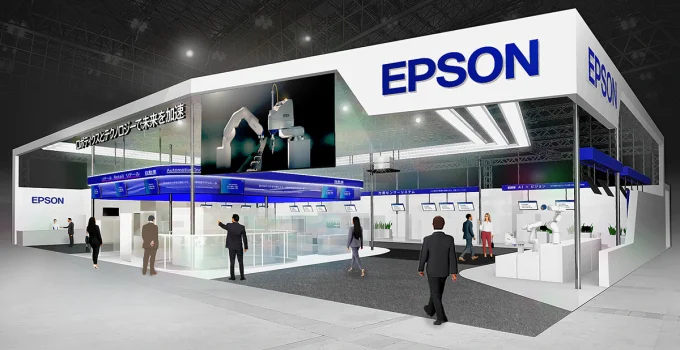
Epson has opened its stand at the International Robot Exhibition 2025 in Tokyo, using the event to show new robotics systems and Ai-enabled development tools aimed at industries dealing with labour shortages, tight quality expectations, and rising automation demands.
The exhibition at Tokyo Big Sight runs from December 3 to 6. Epson framed its theme as an effort to accelerate the future of manufacturing through robotics and software, with new demonstrations spanning automotive production, EV batteries, retail automation, life sciences, and food handling.
Expanding Ai In Robot Development
Epson presented an Ai-enabled version of its RC+ development environment, which now incorporates chatbot functions and program generation tools built on generative Ai. The vendor said the tools are designed to lift development efficiency by supporting cloud collaboration, remote monitoring, and open standards such as OPC UA and SRCI.
The development environment also supports libraries compatible with ROS, creating a more flexible interface for integrators and researchers.
A spokesperson at the stand said visitors could see how generative tools accelerate development tasks. “We wanted to show what happens when robot programming becomes more intuitive, more open, and less tied to manual configuration,” the spokesperson said.
Automotive Paint Inspection
The automotive section included a demonstration developed with Subaru. The system uses spectral vision to detect colour differences on painted bumpers without relying on physical contact. Mixed-colour sample parts provided by Subaru allowed engineers to show how the technology stabilises paint inspections in environments where accuracy and repeatability matter.
Staff on the floor said the system responds to long-running pressure in the automotive sector to automate appearance inspections and reduce variability between production shifts.
EV Battery Transport
Epson also introduced the LS50 SCARA robot, engineered for EV battery transport. The model supports 50 kg payloads and is designed to move batteries with stable speed across production lines.
A comparative demonstration with the previous LS20 model showed the difference in handling weight and acceleration. Engineers said the system reflects the growing pace and size of EV battery manufacturing, where compact handling equipment is increasingly strained.
Retail Kiosk Development
In the retail zone Epson unveiled a compact nail polish kiosk called Huey. The unit extracts colours from a customer’s smartphone image and produces custom nail polish on demand.
The company positioned the kiosk as a response to space constraints in retail stores. Operators can generate more personalised products without expanding floor area. Staff said the system gives retailers a fresh revenue model built around on-demand colour creation.
Life Sciences Automation
The AX6 collaborative robot featured in the life sciences section. The unit automates specimen pre-processing tasks common in laboratories. Demonstrations ran through Python scripts and block-based programming to show how the robot can be integrated into diagnostic workflows.
Researchers at the booth highlighted the continued push for consistency in medical and scientific environments. They argued that robots reduce the risk of manual variance during specimen handling.
Food Industry Transport
For food processing, Epson introduced the RS6 ceiling-mounting SCARA robot. The robot targets macaron transport in bakery and dessert lines where space is limited. A demonstration combined ceiling mounting, conveyor tracking, and vision recognition to move food items at high speed.
Representatives noted that many food producers are dealing with persistent labour shortages and see ceiling-mounted systems as a way to reclaim floor space while lifting production throughput.
Related: Best Business Laptops for work & school
Related: Best Gaming Laptops
Related: Best Portable Laptop
Expanding Proposals For Manufacturing
Epson rounded out the exhibit with two manufacturing technologies aimed at reducing process complexity.
The first was a direct-to-shape printing system combining the high-precision S800 inkjet head with a 6-axis robot. The system prints onto complex three-dimensional surfaces, offering manufacturers a path to reduce steps in finishing processes while cutting waste.
The second was a metal 3D printing display delivered with US-based 3DEO. Epson highlighted 3DEO’s Intelligent Layering process as a way to enable additive manufacturing for low-volume, high-mix production and complex geometries.
A representative said the combination of robotics, software, and Ai reflects a long-term direction for the company’s automation strategy. “We want people to see how these pieces fit together in real workplaces, not just as concepts,” the representative said.
Last Updated on December 3, 2025 by Nick Ross


