
Surprisingly Useful AI Article Enhancements
Asus has unveiled a new range of servers built on AMD’s 6th-generation EPYC 9006 processors, targeting enterprise customers running AI, virtualisation, storage and cloud workloads.
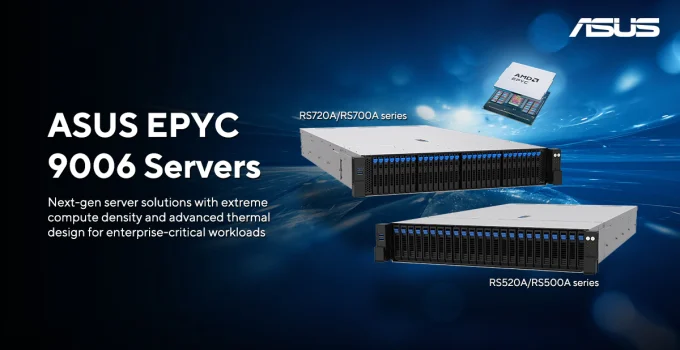
The new portfolio is split into two series: the dual-socket RS700A/720A for compute-dense deployments and the single-socket RS500A/520A for environments where space efficiency and deployment flexibility are priorities.
Both series feature PCIe 6.0 connectivity, MRDIMM memory support and high-density E3.S storage, alongside a set of Asus-developed thermal management and chassis design features aimed at reducing total cost of ownership.
Dual-socket series targets AI inference and complex simulation
The RS700A/720A series is the higher-end of the two lineups, designed for workloads such as AI inferencing and complex simulations that demand dense compute capacity.
The dual-socket configuration supports 32 DIMM slots with MRDIMM compatibility, delivering high memory bandwidth for data-intensive tasks. Storage capacity extends to 32 E3.S bays within a 2U form factor, and the platform supports full PCIe 6.0 throughput.
The series is built around AMD’s EPYC SP8 server CPU architecture, which Asus has paired with its own engineering additions to address cooling, serviceability and system reliability.
Single-socket series aimed at mainstream enterprise and constrained racks
The RS500A/520A series takes a different approach, prioritising space efficiency with a chassis depth under 800mm. Asus positions it as a fit for mainstream enterprise workloads and rack-constrained environments where full dual-socket density is not required.
Despite the smaller footprint, the single-socket series retains PCIe 6.0 capabilities and E3.S storage support. Asus has also designed component modularity into the platform, with shared parts between the RS500A/520A and the larger RS700A/720A series to simplify procurement and servicing across mixed deployments.
Proprietary engineering features span cooling, modularity and storage placement
Asus has layered several proprietary features on top of the AMD EPYC 9006 platform across both server series.
The DC-MHS modular architecture uses a zone-partitioned chassis that separates I/O, HPM, fan and storage modules into distinct sections. The approach is designed to speed up development cycles, reduce capital costs and allow individual modules to be serviced without disrupting the broader system.
A patented feature called DIMM.2 Innovation repositions M.2 storage into the cooler DIMM region of the chassis. Asus claims this eliminates thermal throttling without the need for additional heatsinks, while also freeing up space for greater scalability.
Thermal Radar 3.0 with PID Control provides real-time fan regulation using algorithmic control, adjusting airflow dynamically to balance energy consumption against cooling requirements under varying workload conditions.
The company has also applied a tool-less chassis design across the range, intended to reduce maintenance time, increase uptime and support sustained performance under high-load AI and HPC workloads.
Asus frames launch as a step toward flexible AI infrastructure
Paul Ju, Senior Vice President at Asus, framed the new lineup as a platform for enterprises looking to scale AI capabilities within existing infrastructure constraints.
“The new Asus server series, powered by 6th-gen AMD EPYC server CPUs, is engineered to power every enterprise workload with flexible, scalable infrastructure,” Ju commented. “The new series empowers businesses with a resilient foundation to achieve computing efficiency and accelerate AI innovation with inference.”
Related: Best Business Laptops for work & school
Related: Best Gaming Laptops
Related: Best Portable Laptop
The dual-series approach reflects a broader trend in the enterprise server market, where vendors are increasingly segmenting their portfolios to serve both high-density compute environments and space-constrained edge or branch deployments from a common platform architecture.
Availability
Asus has indicated the RS700A/720A series and RS500A/520A series servers will be available soon, though specific pricing and shipping dates have not been disclosed. The company is directing prospective customers to contact their local Asus representative for further details.
Last Updated on July 28, 2026 by Nick Ross


