
Surprisingly Useful AI Article Enhancements
AMD has launched its latest high-performance computing solutions, introducing the 5th Gen AMD EPYC processors, AMD Instinct MI325X accelerators, and a range of next-gen networking products at the Advancing Ai 2024 event. The new products aim to support enterprises and end-users in scaling Ai capabilities across various industries.
Partners such as Dell, Google Cloud, HPE, Lenovo, Meta, Microsoft, and Oracle Cloud Infrastructure joined AMD to showcase how they are leveraging AMD’s expanding Ai solutions for enterprise and cloud computing.
AMD Chair and CEO Dr Lisa Su highlighted the company’s commitment to Ai-driven innovation.
“The data centre and Ai present significant growth opportunities for AMD,” Su said. “With the new EPYC CPUs, AMD Instinct GPUs, and Pensando DPUs, we are delivering compute solutions that meet our customers’ most important workloads. We also anticipate the Ai accelerator market growing to $500 billion by 2028.”
New Solutions for Data Centres
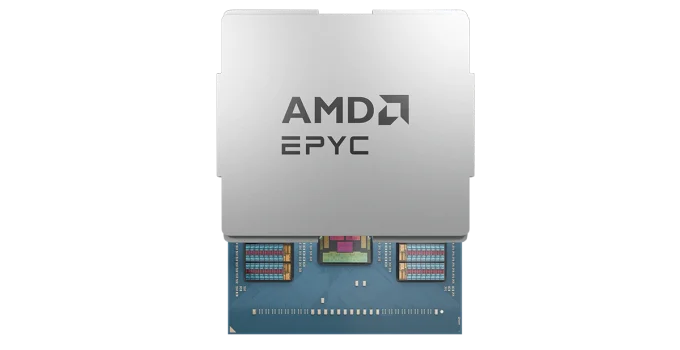
AMD revealed a broad portfolio of solutions designed for Ai, enterprise, and cloud workloads. The new AMD EPYC 9005 Series processors offer up to 192 cores, built on the “Zen 5” architecture, and are now available through OEMs and ODMs. These processors are optimised for diverse data centre needs, providing record-breaking performance across various platforms.
The company also launched the AMD Instinct MI325X, part of its annual Ai accelerator cadence. The MI325X aims to deliver memory capabilities suited for demanding Ai workloads. AMD also shared plans for its next-gen MI350 series accelerators, expected to launch in late 2025, which will extend memory capacity and performance for generative Ai applications.
AMD has made significant improvements to its ROCm software stack, which now supports more than one million models. The Instinct MI300X, which was launched in late 2023, has tripled the number of supported models and doubled inferencing and training performance across many popular Ai models.
Enhancing Ai Infrastructure
In addition to processors and accelerators, AMD expanded its high-performance networking portfolio to meet the evolving demands of Ai infrastructure. The AMD Pensando Salina DPU is designed to provide a high-performance front-end network for Ai systems. Meanwhile, the AMD Pensando Pollara 400 NIC offers an Ultra Ethernet Consortium-ready solution, reducing system complexity and improving time to production.
AMD partners have been quick to adopt these new technologies. Since its launch, the MI300X accelerators have been deployed at scale by cloud, OEM, and ODM partners. They are already being used by millions of users for popular Ai models such as OpenAi’s ChatGPT and Meta’s Llama, along with over one million open-source models on platforms like Hugging Face.
Google emphasised the role of AMD EPYC processors in powering a wide range of instances, including Ai, high-performance computing, and confidential computing. The tech giant also announced that EPYC 9005 Series-based virtual machines will be available in early 2025.
Oracle Cloud Infrastructure shared how it uses AMD EPYC CPUs, AMD Instinct accelerators, and Pensando DPUs to provide efficient compute and networking infrastructure for high-profile customers, including Uber, PayPal, and Fireworks Ai.
Collaboration with Ai Leaders
AMD’s collaboration with Ai leaders was a key focus at the event. Databricks discussed how its models and workflows run on AMD Instinct and ROCm. The company reported a 50 per cent increase in performance on Llama and Databricks proprietary models, thanks to the Instinct MI300X’s large memory capacity.
Microsoft CEO Satya Nadella also highlighted the company’s deep collaboration with AMD. Microsoft has been working with AMD to optimise its Ai offerings, using the MI300X to run Azure’s GPT workloads. Nadella mentioned that future generations of AMD Instinct accelerators, including the MI350 series, will play a key role in Microsoft’s Ai infrastructure.
Meta detailed how it uses AMD EPYC CPUs and AMD Instinct accelerators across its compute infrastructure. The MI300X has already been deployed to serve all live traffic on Meta’s Llama 405B. Meta is also working with AMD to optimise Ai performance across silicon, systems, networking, and software.
Leading OEMs such as Dell, HPE, Lenovo, and Supermicro are expanding their EPYC processor-based platforms to modernise data centres for the Ai era.
Related: Best Business Laptops for work & school
Related: Best Gaming Laptops
Related: Best Portable Laptop
Expanding the Open Ai Ecosystem
AMD continues to invest in the open Ai ecosystem by expanding the ROCm open-source software stack. New features and optimisations have been introduced to help developers maximise performance from AMD Instinct accelerators. Leaders from Essential Ai, Fireworks Ai, and Reka Ai joined AMD to share how they are optimising models across AMD’s hardware and software platforms.
AMD also hosted a developer event with key figures from Microsoft, OpenAi, Meta, and Cohere. Presentations focused on how developers are unlocking Ai performance through vendor-agnostic programming languages and optimising models on AMD Instinct accelerators.
Enterprise Ai PCs with Ryzen
AMD also launched its new Ryzen Ai PRO 300 Series processors at the event. These processors are designed to power enterprise Ai PCs, including Microsoft Copilot-enabled laptops. The new Ryzen Ai PRO 300 series features the latest “Zen 5” architecture and AMD XDNA 2 technologies.
The processors are tailored for business users, offering enhanced productivity and security features. With 55 NPU TOPS of Ai performance, the Ryzen Ai PRO 9 HX processor can process Ai tasks locally on enterprise laptops.
HP and Lenovo are among the OEM partners expanding their commercial offerings with the new Ryzen Ai PRO 300 Series processors, with over 100 platforms expected to hit the market through 2025.
Last Updated on October 11, 2024 by Nick Ross


