
The face of Australian retailing has undergone dramatic change over the past few years. With online shopping on the increase, expansion in omnichannel sales channels and customers having greater demands, pressure mounts on retailers to be more efficient than ever before. At the back of every successful shop front is an important factor that always remains unseen: the stockroom, warehouse or backroom where inventory management truly happens.
For the majority of Australian retailers, success or failure hinges on the efficiency of how they set up their storage spaces. Clever businesses are discovering that the key to effective operations is not spending money on expensive technology, it’s combining digital technology with utilitarian, well-engineered shed storage and shelving systems that maximize utilized space. This approach is helping Cairns to Hobart retailers reduce waste, speed up order fulfilment and create healthier working environments.
The Challenge: Limited Space And Increasing Stock Complexity
The shift to multichannel and e-commerce has created difficulty for Australian retailers. What was once a boutique for a large part that held inventory for in-store customers now must deal with online purchases, click-and-collect points and traditional retailing all located at the one place. That means holding more diverse inventory, dealing with faster turnaround times and the challenge of logistics of multiple sales channels in one building.
There has become a common set of pain points that is almost universal throughout the industry. Overflowing storage rooms anger staff by making it difficult for them to locate products in a timely way, which leads to irate customers and late shipments. Missing inventory translates directly into missing sales and an inaccurate product count. Poor design layout means that employees spend valuable time walking through narrow aisles or rummaging through cluttered shelves. Smaller stores operating on thin margins are disproportionately impacted by inefficiency.
The problem is most severe in the large cities where commercial real estate is costly. Shopkeepers in Brisbane, Melbourne and Sydney often have the problem of whether to invest in additional storage space or be resourceful with what they can do. However, regional businesses physically may have more room but lack the advanced machinery to maximize it. The solution, more and more, is to reimagine the technology and physical infrastructure behind their inventory management.
Tech-Driven Storage Solutions In Retail
Technology is reshaping the manner in which Australian retailers manage their backroom operations, with solutions ranging from simple to sophisticated based on business need and cost. At the simplest level, barcode scanning solutions are all but ubiquitous, allowing employees to accurately capture inventory movements and maintain accurate stock levels. Solutions are fully integrated into point-of-sale systems, with real-time visibility of what’s available and what needs to be reordered.
More advanced operations are embracing RFID (Radio Frequency Identification) technology, which is stepping tracking up to a new level. As barcodes must be scanned line-of-sight, RFID tags are read remotely and in bulk. An RFID reader carried by a staff member moving through a stockroom will inventory in minutes, not hours. It has been particularly useful for apparel retailers that have many individual pieces and home improvement centres with high-value tools.
Cloud-based inventory management software has brought enterprise-grade tools within reach of small and medium businesses. Such systems provide in-depth analysis of stock turnover, track slow-moving inventory and even predict future demand based on past patterns. Integrated with e-commerce sites, they automatically synchronise the stock levels of all the sales channels to prevent the dreaded overselling nightmare.
Certain forward-thinking retailers are exploring IoT-enabled smart shelving units that use weight sensors and electronic displays to monitor stock levels remotely. They can alert staff when products are running low or flag discrepancies between physical stock and database information. While new to the Australian marketplace, they indicate the way the industry is headed. The key to success lies in the fact that these units of digital technology work harmoniously in conjunction with well-designed physical storage facilities that ensure streamlined working processes and easy access.
The Role Of Shed Storage And Shelving Systems
As technology makes the news, physical space organisation of storage remains central to retail efficiency. Many Australian businesses are embracing purpose-designed shed storage and shelving that are long-lasting, flexible and cleverly intelligent in space management. These systems provide the basis on which technological solutions can best operate.
The beauty of modern shelving systems is that they are able to maximize vertical space especially useful if floor space is limited or expensive. Heavy-duty shelving systems are able to carry heavy loads at a number of different levels, turning dead overhead space into valuable storage real estate. Adjustable shelves allow stores to modify arrangements as a mix of inventory changes, accommodating anything from small packaged items to bulk items.
Effective shelving organisation yields benefits far in excess of space utilisation. Employees can locate items easily when they are well-marked and properly categorised, reducing order shipping times and levels of customer service. Open aisle and securely anchored shelving also yield safer working environments, reducing accident potential and workers’ compensation claims. For firms with perishable product lines, effective shelving allows for effective FIFO (first in, first out) stock rotation, saving waste.
Various retail industries call for varying shelving methods. Fashion stores appreciate configurations that support hanging storage as well as folded inventory with variable heights to store various types of garments. Home improvement stores demand rugged versions to hold building materials, tools and machinery with deep shelves to store large items. Food retailers need food-grade materials and configurations that ensure temperature control and cleaning simplicity. The best installations combine industry-specific shelving with generic solutions to create adaptable systems that will adapt as business needs change.
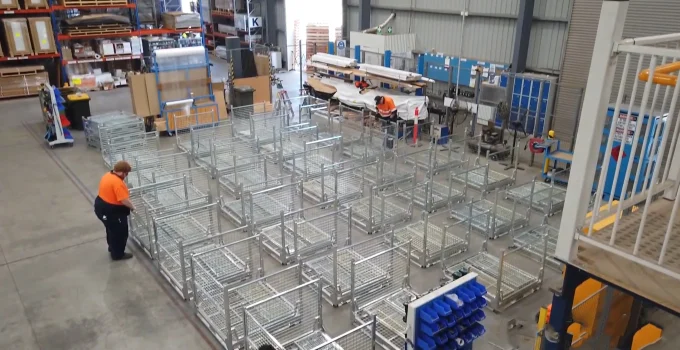
To further enhance storage efficiency, integrating stillage solutions into shelving systems can provide additional benefits. Stillage units, such as mesh pallet cages and post & pipe stillages, offer secure, stackable storage options ideal for bulky or irregularly shaped items. These units are forklift-compatible and designed for heavy-duty use, making them suitable for various industries, including manufacturing, logistics and retail.
Case Studies And Practical Applications
Imagine a Brisbane inner suburb boutique clothing retailer with the classic issue of cramped backroom space but growing online sales. By using RFID tagging of all items and rearranging their storage room with modular shelving units, they reduced order processing time by approximately 40 per cent. Employees could locate specific items in an instant using handheld RFID scanners, while the vertical shelving system allowed them to stock seasonal products above and maintain current collections at eye level. Within eight months, the investment paid for itself in terms of productivity gain and stock discrepancies elimination.
Related: Best Business Laptops for work & school
Related: Best Gaming Laptops
Related: Best Portable Laptop
There is one regional hardware store in rural New South Wales that approached fixing their organisational issues differently. With ample outdoor area but limited indoor storage, they went for weather-resistant shed storage systems to hold bulk inventory and seasonal goods. By integrating barcode tracking with clearly delineated shelving spaces, they had an efficient system where staff could locate any product within two minutes. The organised design also maximised job safety, preventing the previous habit of piling heavy boxes randomly. In high-demand seasons, the time gained in finding and recovering products enabled them to have more customers without needing to add more employees.
These examples illustrate a common theme: the secret to success is fitting together the right combination of physical infrastructure and technology to serve specific business needs. Not every retailer requires high-end RFID solutions or automated systems. Most of the time, greatest gains come from change of a simple variety, adequate shelving, good labelling and orderly maintenance facilitated by appropriate technology for the size of the business.
On a similar theme, you can check out pallet racking Gold Coast specialists, Storeplan.
Future Of Retail Storage In Australia
In the future, Australian retail warehousing will continue to be driven by innovation through automation, sustainability and advanced data analytics. Automated storage and retrieval systems (AS/RS) are no longer the reserve of large distribution centres and are now available to mid-size operations due to modular and scalable technologies. They have the ability to significantly enhance storage density while minimising physical labour associated with inventory management.
Sustainability is increasingly influencing the selection of storage, with stores seeking shelving from recycled materials or sustainably sourced wood and steel. Energy-efficient warehouse design with a low heating and cooling cost is also gaining traction, particularly with companies that deal with temperature-sensitive commodities. The push towards the circular economy translates to storage systems being designed to be more durable, flexible and ultimately recyclable.
The creation of hybrid warehouse-retail concepts, where stockrooms are mini-fulfilment centres for internet orders, is changing the way retailers think about space optimisation. These concepts require storage systems that can handle quick picking for internet orders and easy restocking for retail fixture replenishment. Technology integration will remain smooth, with augmented reality helping staff locate products and artificial intelligence making storage configuration based on picking patterns and product velocity easier.
Australasia’s top-performing retailers understand that operational efficiency begins in the stockroom, rather than on the shop floor. By deliberately combining modern storage technology with logically designed shed storage and shelving systems, businesses of all sizes can noticeably improve productivity, save costs and create more productive workplaces for their staff.
The solution does not necessarily require drastic changes or massive amounts of money. Start by doing an honest evaluation of your current storage setup, your bottlenecks, tracking the time it takes for average tasks and soliciting staff comments on daily annoyances. Then make improvements with a focus on those that will have the most impact, whether that means deploying simple inventory software, rethinking your shelving configuration or purchasing more durable storage equipment.
In a more competitive retail environment, these stockroom efficiencies aren’t luxuries, they’re necessities. The successful merchants will be those that value that each minute of time saved in the stockroom is a minute that can be redeployed toward customer service, strategy or expansion opportunities. Solid physical and digital storage solutions are the pathway to that success.
Last Updated on July 7, 2026 by Nick Ross


With the rise of multichannel retail, it’s crucial to find ways to manage diverse inventory types without overhauling everything. Combining digital tools with a smart shelving system seems like a clever and cost-effective approach.